
Introducing Decision Engineering
Influencing outcomes by examining Decisions

This introductory article is about Decision Engineering framework, prerequisites for building a decision engineering product and some of the low hanging fruit one can identify to generate business value.
Decision Engineering
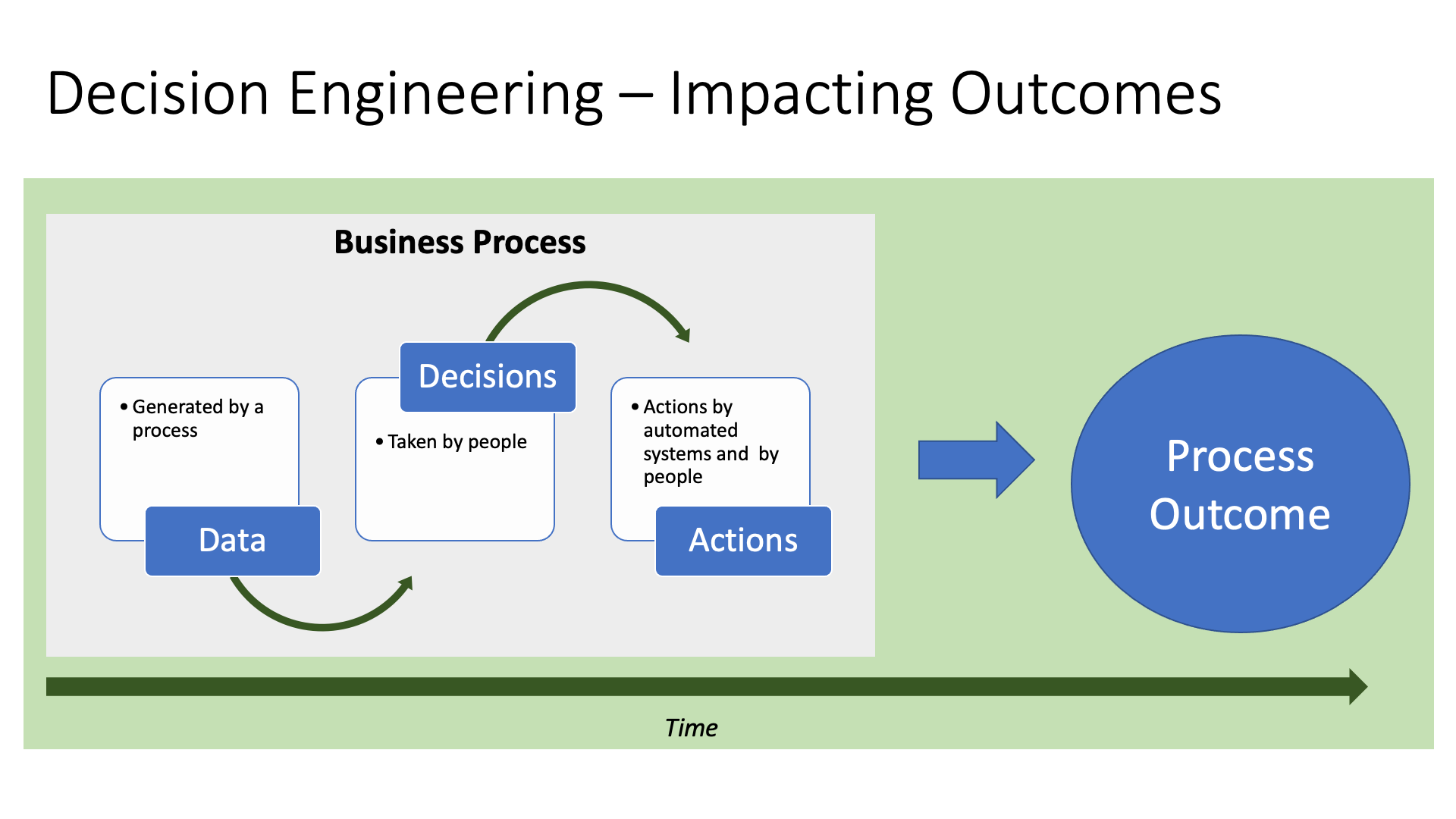
Decision Engineering is about influencing business outcomes to generate value. Outcomes are the result of one or more actions, many of them a consequence of a series of decisions, and the decisions which in turn are informed by data. In essence we are not talking just about data driven decision-making but tracing the decisions to actions and evaluating the outcomes that occur at a later point in time.
Understanding Outcomes
Business outcomes are manifestations of one or more processes, and several decisions and actions interact to generate an outcome. Outcomes are not just numbers like the total sales. Sales is the result of several interactions between the customers, sales reps, partners and the products or services themselves. Deploying tools focuses on the sales numbers may generate some activity, like better leads, but will not move the needle for the company.
Let us look at the sales process. Increasing sales (usually improving the rate of sales or sales per unit time) is an outcome every organization desires. The sales process consists of multiple entities - customers, customer influencers, marketing campaigns, product features, sales rep. These entities are diverse, are connected, interdependent and in many cases adaptive. All of this points to a complex adaptive system.
To understand outcomes therefore is not simply understanding the parts and how each part is performing. Complex systems theory tells us that the whole is more than the sum of its parts. Knowledge of parts alone is not sufficient for understanding the whole.
An approach for understanding a sales process could be to look at the entire process using a technique called Process Mining.
Impacting the Outcomes.
Process mining while key to understand the system, it alone is not sufficient for impacting an outcome. To go about designing a decision product to impact outcomes requires careful examination of data (generated by a process), the knowledge required to turn the data into a decision context, the actionability of the decision and finally an ability to measure outcomes that allows us to see the impact of diversity, connectedness, adaptation and of course interdependence. Therefore a few prerequisites for building a decision engineering product would be:
Identify the complex process which has a measurable outcome.
Identify the systems where the process is executed
Identify actions taken within the system, the entities taking the action, when it is taken and who is taking it (an automated system action, people action etc)
Identify decisions implicit and explicitly made prior to the action
Identify data within the same system and outside the system required for decisioning
Process Identification
Business Outcomes are usually associated with one or more processes. It is better to identify a business outcome that can be attributed to a single process than a collection of processes when attempting a minimum viable product. The process should have a measurable outcome.
System Identification
Execution of a business process usually entails a system. This could be an enterprise system like an ERP or a CRM and sometimes a module within these systems. Identifying the system is the first step to understand the process
Data Identification
Once we identify the system, getting access to the data within the system is easier. However the data if it is available in a source other than the transactional system where the process related transactions are executed there may be a time delay between this data source and the actual transactional data source.
Action Identification
Identifying the action events is an important part of Decision Engineering. Building the action events out of the data within the system would take some data transformation. This would require some data munging before we can identify the actions and the metadata associated with the action to determine when the action was taken.
Decision Identification
Decisions precede actions and may be again implicit or rule based especially when it comes to automated systems. Sometimes actions are acted on by decisions and sometimes are rule driven. If the system executes actions based on rules these rules can be construed as decisions and can be recorded as such. In case of actions triggered by humans, there will be reports and analytics that inform the decision which lead to action. These decision contexts can be derived from the data.
Decision Engineering Process
A transformation of data and knowledge into a decision context is an important and critical part of decision engineering. When making decisions, we often think about the data we have and the knowledge we have about the data. However, we sometimes forget to take into account the context of the data and the intelligence of the people making the decisions. An important part of Decision Engineering product is bringing together data, knowledge about the data and some intelligence to create a decision context. These decision contexts can be used to make more effective decisions.
The first step in decision engineering is to understand the data and the knowledge about the data. This data can come from many sources, including databases, documents, images, videos etc. To make sense of the data however we need context in the form of relationships with other data, documents, images etc. This can be represented in the form of a Knowledge graph. Once the data is understood and we have gained contextual understanding through a knowledge graph we now can transform it to a decision context. This transformation is done by adding intelligence to the knowledge graph. Intelligence for the purpose of decision making is a set of patterns mapped to a set of decisions. This intelligence can be built using Graph based machine learning. Once the data, knowledge and intelligence have been transformed into a decision context, in the form of a knowledge graph decisions can be made when the patterns occur.
Making decisions more effective requires leveraging data, knowledge and intelligence. Decision engineering is a powerful tool that can be used to make better decisions.
In this introductory article we have provided a high level overview of building a decision engineering product and what goes into building a DE (Decision Engineering) Product. In future articles we will look at examples of Decision Engineering and provide tangible use cases that can help Data Science and ML algorithms to build the intelligence necessary for Decision Engineering.
To summarize Decision engineering can be construed as the process of bringing together data, knowledge and intelligence to create a decision context. This decision context can then be used to make more effective decisions.